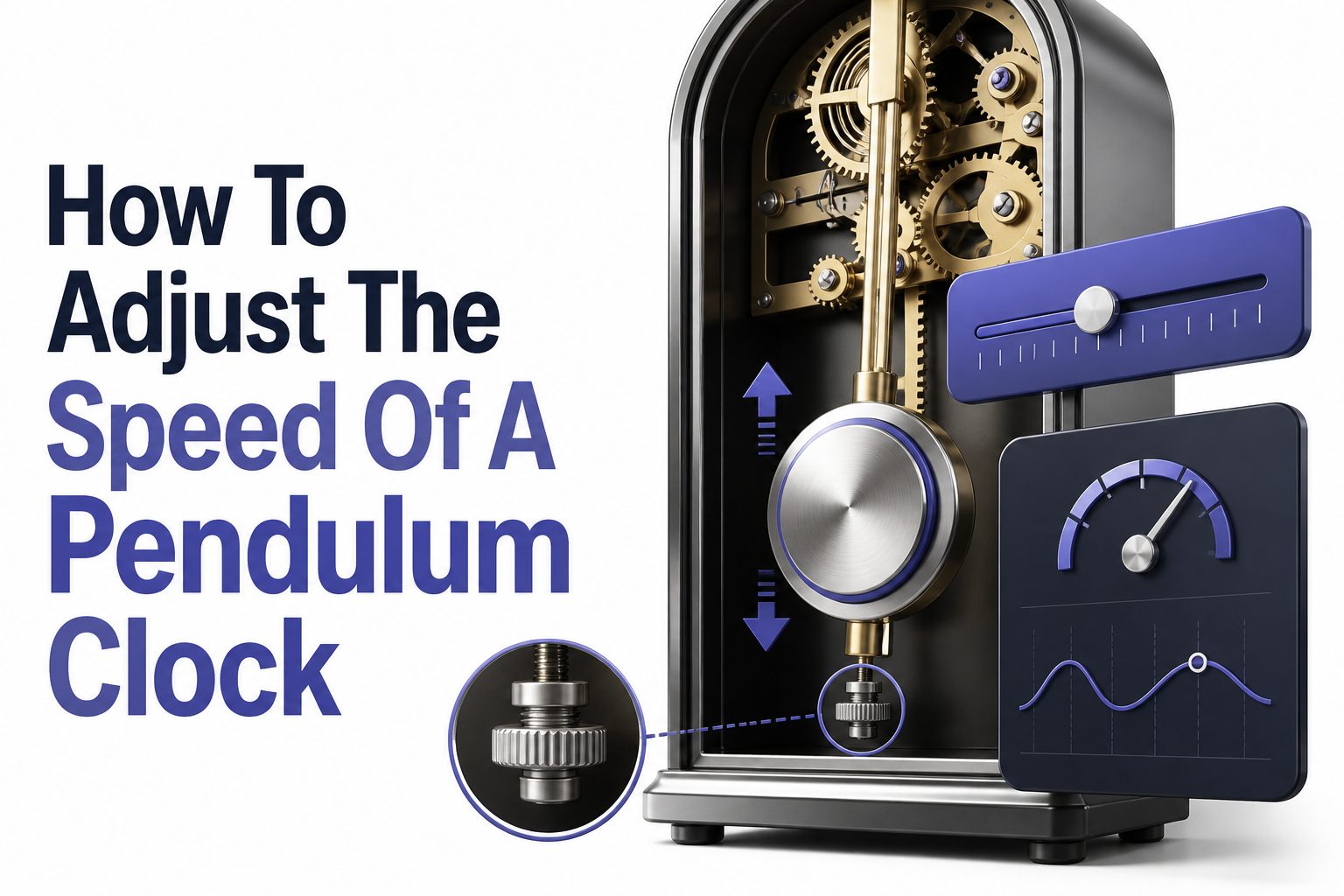
A pendulum clock has a character that modern clocks rarely match. Its steady tick, visible motion, and mechanical rhythm make time feel alive in the room. When it starts gaining or losing minutes, though, that charm can quickly turn into daily frustration. Knowing how to adjust the speed of a pendulum clock helps you bring the clock back into reliable timekeeping without guessing or forcing the mechanism.
Most pendulum clocks are adjusted by changing the effective length of the pendulum. A shorter pendulum swings faster, while a longer pendulum swings slower. The process is simple, but patience matters. Small changes, careful observation, and a consistent reference time will give you far better results than large adjustments made in a hurry.
Why Pendulum Clock Speed Changes
A pendulum clock depends on a steady swing to measure time. When the pendulum’s length changes even slightly, the clock’s rate changes too. Temperature, humidity, floor movement, worn parts, and recent relocation can all affect how accurately the clock keeps time.
Many clocks also settle differently after being moved, cleaned, or wound. A clock that was accurate in one room may run fast or slow in another. Before adjusting anything, give the clock a full day in its new position so you can judge its real behavior.
How the Pendulum Controls Timekeeping
The pendulum works as the clock’s regulator. Each swing controls the release of the gears inside the movement. When the pendulum swings too quickly, the clock gains time. When it swings too slowly, the clock loses time over hours or days.
The adjustment usually happens at the pendulum bob, which is the round weight near the bottom. Raising the bob shortens the pendulum and speeds the clock. Lowering the bob lengthens the pendulum and slows the clock.
Important facts before adjusting:
- Raise the pendulum bob to make the clock run faster.
- Lower the pendulum bob to make the clock run slower.
- Make only small turns at a time.
- Check accuracy over 24 hours, not just one hour.
- Keep the clock level before judging its timekeeping.
- Never force an old or stuck adjustment nut.
Preparing the Clock for Accurate Adjustment
Start by placing the clock on a firm, level surface or making sure the wall clock is hanging securely. A clock that leans forward, backward, or to one side may tick unevenly, which can affect both reliability and accuracy.
Use a trusted time source such as your phone, an atomic clock, or an official time website. Set the clock exactly, then let it run normally for 24 hours. Write down whether it gains or loses time and by how many minutes.
Setting the Clock in Beat
A clock is “in beat” when the tick and tock are evenly spaced. If the sound is uneven, the pendulum may not receive steady power from the movement. This can cause stopping, poor accuracy, or inconsistent results after adjustment.
For wall clocks, gently shift the bottom of the case slightly left or right until the tick-tock becomes even. For mantel clocks, adjust the clock’s position on the surface. If the clock still sounds uneven, the crutch may need professional adjustment.
Basic adjustment checklist:
- Confirm the clock is fully wound.
- Make sure the pendulum is correctly attached.
- Check that the case is level and stable.
- Listen for an even tick-tock rhythm.
- Set the exact time from a reliable source.
- Let the clock run for one full day before changing the bob.
How to Adjust a Clock That Runs Fast
If your pendulum clock gains time, the pendulum is swinging too quickly. To slow it down, move the pendulum bob lower. Most clocks have a small rating nut beneath the bob that controls its position.
Turn the nut in the direction that lowers the bob, usually counterclockwise when viewed from below. Make a small adjustment, such as half a turn or one full turn, then reset the time and observe the clock for another 24 hours.
How to Adjust a Clock That Runs Slow
If your clock loses time, the pendulum is swinging too slowly. To make it run faster, raise the pendulum bob slightly. This shortens the effective pendulum length and increases the rate of swing.
Turn the rating nut so the bob moves upward, usually clockwise when viewed from below. Avoid making big changes unless the clock is losing a large amount of time. Small corrections protect the movement and make the final setting easier.
Pendulum adjustment comparison:
Adjustment Needed | What to Do | Result
Clock runs fast | Lower the bob | Clock slows down
Clock runs slow | Raise the bob | Clock speeds up
Clock stops often | Check level and beat | More reliable running
Time varies daily | Observe longer | Better diagnosis
Nut feels stuck | Stop adjusting | Prevent damage
Using Small Adjustments for Better Accuracy
Small adjustments are the key to regulating a pendulum clock properly. A tiny change in bob height can affect the clock by several minutes per day, depending on the movement and pendulum length.
After each adjustment, reset the hands to the correct time and let the clock run for a full day. If it improves but is still off, repeat the process. This gradual method is how experienced clock owners avoid chasing accuracy back and forth.
Tracking Time Changes Over Several Days
One day gives you a useful starting point, but several days reveal a clearer pattern. A clock may appear fast one day and closer the next due to winding tension, room temperature, or normal mechanical variation.
Keep a simple note with the date, time set, time gained or lost, and adjustment made. This record helps you avoid repeating the same correction and makes it easier to know when the clock is close enough for daily use.
Simple tracking format:
Day 1:
Time difference: 6 minutes fast
Adjustment: Bob lowered one half turn
Day 2:
Time difference: 3 minutes fast
Adjustment: Bob lowered one quarter turn
Day 3:
Time difference: 1 minute fast
Adjustment: No change
Day 4:
Time difference: Still close
Result: Regulation acceptable
Adjusting Grandfather Clocks
Grandfather clocks usually use a long pendulum with a large bob and a rating nut beneath it. Because the pendulum is long, one small turn may have a noticeable effect, but the change is often more gradual than on a small mantel clock.
Open the case carefully and stop the pendulum before turning the nut if access is tight. After adjustment, restart the pendulum with a gentle sideways push. Do not swing it widely, because a strong push can disturb the beat.
Adjusting Mantel and Shelf Clocks
Mantel clocks often have shorter pendulums, so they may respond more sharply to small changes. Some models have a rating nut below the bob, while others use a small regulating arbor on the clock face.
If your clock has a front regulator, it may be marked fast and slow. Use the correct clock key and turn only a small amount. If the markings are missing or unclear, test gradually and record the results before making further changes.
Practical tips for different clock types:
- Grandfather clocks often need patience because cases can shift on flooring.
- Mantel clocks should sit on a stable, flat surface.
- Wall clocks need secure hanging and a steady vertical position.
- Antique clocks may need gentler handling than newer models.
- Regulator dials should be turned only with the proper key.
- Decorative pendulum clocks may not all have true mechanical regulation.
Common Mistakes That Make Clocks Less Accurate
The most common mistake is adjusting too much at once. A full turn may be too large for some clocks, especially smaller antique models. When the clock suddenly changes from fast to slow, it becomes harder to find the accurate setting.
Another mistake is adjusting before the clock is level or in beat. If the tick-tock is uneven, changing the pendulum length may not solve the real problem. Always correct position and beat before focusing on speed.
When Winding Affects Clock Speed
Many mechanical clocks run slightly differently depending on spring tension or weight position. A clock may run a little faster right after winding and slower as the spring relaxes, especially if the movement needs service.
Wind the clock on a consistent schedule before evaluating accuracy. If it is designed for weekly winding, choose the same day each week. Consistent winding removes one variable and gives you a better reading of the clock’s true rate.
Mistakes to avoid:
- Making several adjustments in one day.
- Moving the hands backward on clocks that should not be reversed.
- Ignoring an uneven tick-tock sound.
- Forcing a tight rating nut.
- Judging accuracy from only a few hours.
- Adjusting while the clock is unstable or recently moved.
How Room Conditions Affect Pendulum Clocks
Temperature can affect pendulum length, especially in older clocks with metal rods. When metal expands in warmth, the pendulum becomes slightly longer and the clock may slow. In cooler conditions, it may shorten and run faster.
Humidity can also affect wooden cases, suspension parts, and lubrication. A clock placed near heating vents, fireplaces, windows, or damp walls may behave inconsistently. A stable indoor location gives the movement its best chance of keeping steady time.
Choosing the Best Location for the Clock
Place the clock where it is protected from vibration and sudden temperature changes. Floors near doors, staircases, or heavy foot traffic can disturb tall clocks. Wall clocks need strong mounting so the case does not shift over time.
Avoid direct sunlight, radiator heat, and air-conditioning drafts. Even if the clock looks good in those spots, the mechanical parts may not agree. A calm location often improves accuracy before any pendulum adjustment is needed.
Best placement tips:
- Choose an interior wall for wall clocks.
- Keep tall clocks away from loose floorboards.
- Avoid direct sun during the hottest part of the day.
- Do not place clocks above heating vents.
- Keep antique clocks away from damp exterior walls.
- Use shims carefully if a floor clock needs leveling.
When the Rating Nut Is Hard to Turn
A rating nut should move with controlled pressure. If it feels stuck, corroded, or uneven, stop before applying force. Forcing the nut can bend the pendulum rod, damage threads, or loosen the bob in a way that affects accuracy.
Try inspecting the area with good light. Dust, tarnish, or old residue may be visible around the nut. If the clock is valuable, antique, or unfamiliar, it is better to let a clock repairer handle the adjustment safely.
When the Clock Still Runs Wrong After Adjustment
If repeated small adjustments do not produce stable results, the issue may be inside the movement. Dry pivots, worn bushings, weak mainsprings, dirty gears, or a damaged suspension spring can all cause poor timekeeping.
A clock that changes rate wildly from day to day usually needs more than pendulum regulation. If it also stops, sounds uneven, or has weak ticking, consider professional servicing. For related upkeep, see [Internal Link: Pendulum Clock Maintenance].
Signs a clock may need service:
- It stops even when fully wound.
- The tick-tock cannot be made even.
- The hands touch each other or the dial.
- The pendulum swing becomes weak quickly.
- The clock gains one day and loses the next.
- The movement has not been cleaned in many years.
Handling Antique Pendulum Clocks Safely
Antique clocks deserve extra care because parts may be worn, handmade, or difficult to replace. Even a small bend in the pendulum rod or suspension spring can affect performance. Handle the pendulum by the rod, not just the bob.
Before adjusting an antique clock, check whether it has special regulation features. Some bracket clocks, Vienna regulators, and French mantel clocks use front regulation or delicate pendulum systems. When unsure, look for the maker’s instructions or consult a specialist.
Knowing When Accuracy Is Good Enough
Mechanical pendulum clocks are not quartz clocks. Many well-maintained household pendulum clocks are considered acceptable if they stay within a minute or two per week. Precision regulators can do better, but ordinary clocks have practical limits.
The goal is reliable, consistent timekeeping rather than perfection. If your clock keeps roughly the same small error each week, you can regulate it more closely. If the error changes constantly, the clock likely needs cleaning, repair, or a better location.
Accuracy expectations:
- A serviced regulator may keep very close time.
- A good household clock may vary slightly across a week.
- Older mantel clocks often need occasional correction.
- Seasonal changes can require minor readjustment.
- Poor consistency matters more than a small steady error.
- Mechanical clocks benefit from regular professional care.
Conclusion
Adjusting a pendulum clock is a careful process, not a complicated one. Once you know that raising the bob makes the clock run faster and lowering it makes the clock run slower, the rest comes down to patience. Level the case, listen for an even beat, set the correct time, and measure the clock’s gain or loss over a full day before touching the rating nut.
Small changes give the best results. Record each adjustment, wait before making another, and pay attention to room conditions that may affect the pendulum. If the clock remains inconsistent, stops often, or resists adjustment, the movement may need cleaning or repair. With steady observation and gentle handling, learning how to adjust the speed of a pendulum clock can help keep a treasured mechanical clock both useful and enjoyable.
FAQ
How often should I adjust a pendulum clock?
Adjust it only when you notice a consistent gain or loss over several days. Seasonal temperature changes may require small corrections, but frequent adjustments usually mean the clock needs leveling, beat correction, cleaning, or repair.
Which way do I turn the pendulum nut?
In most clocks, turning the nut clockwise raises the bob and speeds the clock. Turning it counterclockwise lowers the bob and slows the clock. If yours behaves differently, make a small test adjustment and observe the result.
Why does my pendulum clock stop after adjustment?
The clock may be out of beat, not level, or the pendulum may have been disturbed. Check for an even tick-tock first. If it still stops, inspect the pendulum attachment or have the movement serviced.
Can I adjust a pendulum clock without stopping it?
It is often safer to stop the pendulum briefly, especially on tall or antique clocks. This reduces the chance of bending the rod or disturbing the suspension. Restart it gently after making the adjustment.
How accurate should a pendulum clock be?
A good household pendulum clock may stay within a minute or two per week. Fine regulators can be more accurate. If the rate changes unpredictably each day, the clock likely needs maintenance rather than more adjustment.
0 Comments