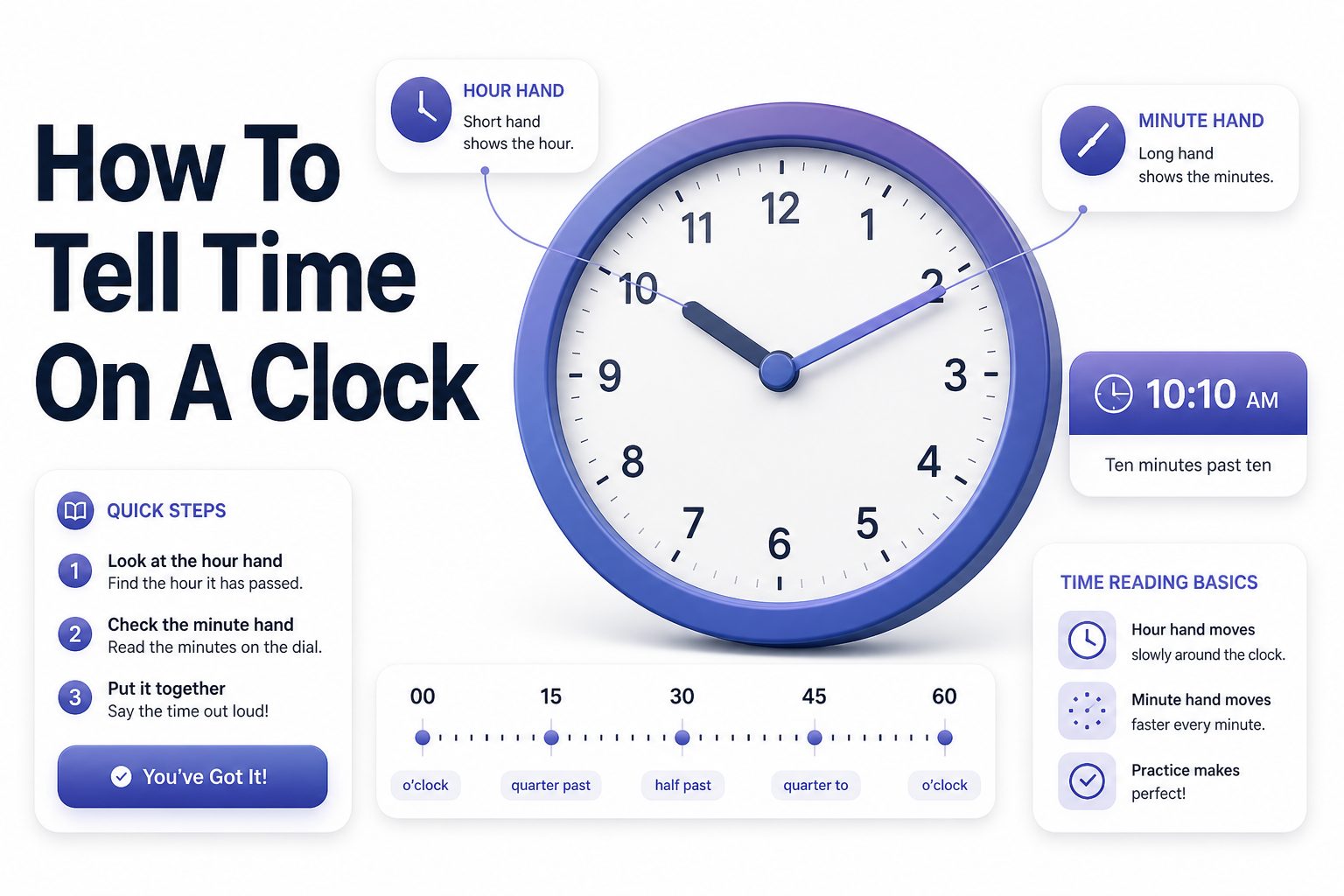
Learning how to tell time on a clock is one of those everyday skills that seems simple once it clicks, but it can feel confusing at first. A clock face has numbers, hands, spaces, and a pattern that all work together. Once you know what each part means, reading time becomes much easier.
If you are teaching a child, helping a student, or brushing up on analog clock skills yourself, the key is to start with the basics and build step by step. This guide explains how to tell time on a clock using clear examples, simple language, and practical tips. You will learn what the hour hand and minute hand do, how to count minutes, how to read common times, and how to avoid mistakes that beginners often make.
Clock Face Basics
An analog clock has twelve numbers arranged in a circle. These numbers show the hours, from 1 through 12. After the hand passes 12, the cycle starts again, which is why clocks repeat the same pattern twice each day.
The spaces between the numbers are just as important as the numbers themselves. Each number represents five minutes when you are reading the minute hand. That means the clock face is also a counting tool for minutes.
Hour Hand and Minute Hand
The shorter hand is the hour hand. It moves slowly around the clock and points to the current hour or the hour you are moving toward. If it is between two numbers, the earlier number is usually the hour.
The longer hand is the minute hand. It moves faster and shows how many minutes have passed after the hour. When it points to 12, the time is exactly on the hour, such as 3 o’clock or 8 o’clock.
Quick Clock Parts Checklist
- The short hand shows the hour.
- The long hand shows the minutes.
- The number 12 means zero minutes or sixty minutes.
- Each number on the clock equals five minutes.
- One full trip around the clock equals one hour.
- The hour hand moves slowly as the minutes pass.
- The minute hand must be read carefully before saying the time.
How Minutes Work on a Clock
To read minutes, start at 12 and count by fives as the minute hand moves around the clock. When the minute hand points to 1, it means five minutes. When it points to 2, it means ten minutes.
This pattern continues all the way around the clock. The 3 means fifteen minutes, the 6 means thirty minutes, and the 9 means forty-five minutes. Once you know the five-minute pattern, reading time becomes much faster.
Counting the Small Lines
Most analog clocks also have small lines between the numbers. These lines represent individual minutes. If the minute hand is two small marks after the 4, you count twenty minutes plus two more minutes.
This is how you read exact times like 2:22 or 7:43. First count by fives to the nearest number, then add the small minute marks after it. This method works on nearly every standard analog clock.
Reading O’Clock Times
O’clock times are the easiest to read because the minute hand points straight up at 12. When this happens, no minutes have passed after the hour. You only need to read the shorter hour hand.
For example, if the hour hand points to 4 and the minute hand points to 12, the time is 4 o’clock. If the hour hand points to 9 and the minute hand points to 12, the time is 9 o’clock.
Common Minute Positions Table
Minute hand position | Minutes shown | Common phrase
12 | 00 | O’clock
1 | 05 | Five after
2 | 10 | Ten after
3 | 15 | Quarter after
4 | 20 | Twenty after
5 | 25 | Twenty-five after
6 | 30 | Half past
9 | 45 | Quarter to
Reading Half Past
Half past means thirty minutes after the hour. On a clock, this happens when the minute hand points to 6. Since half of an hour is thirty minutes, the phrase “half past” is easy to remember.
If the hour hand is between 2 and 3 and the minute hand points to 6, the time is 2:30. You say “half past two” because thirty minutes have passed after two o’clock.
Why the Hour Hand Moves Between Numbers
Beginners often expect the hour hand to point exactly at a number. In real life, it moves slowly as the minutes pass. At half past, the hour hand sits halfway between the current hour and the next hour.
This movement gives an extra clue. If the minute hand is at 6 and the hour hand is between 10 and 11, the time is 10:30, not 11:30. The hour is still the number it has already passed.
Reading Quarter After and Quarter To
Quarter after means fifteen minutes after the hour. The minute hand points to 3 because fifteen minutes is one quarter of a full hour. For example, 5:15 can be said as quarter after five.
Quarter to means fifteen minutes before the next hour. The minute hand points to 9 because forty-five minutes have passed, leaving fifteen minutes until the next hour. For example, 5:45 can be said as quarter to six.
Helpful Phrases for Reading Time
- 1:00 means one o’clock.
- 1:15 means quarter after one.
- 1:30 means half past one.
- 1:45 means quarter to two.
- 2:05 means five after two.
- 2:50 means ten to three.
- 6:25 means twenty-five after six.
- 6:55 means five to seven.
How to Read Exact Time
To read exact time, begin with the hour hand. Find the number it has most recently passed. That number tells you the hour. Then look at the minute hand and count the minutes from 12.
For example, if the hour hand has passed 7 and the minute hand points to 4, the time is 7:20. If the minute hand is one small mark after 4, the time is 7:21.
Step-by-Step Reading Method
First, check the shorter hand and identify the hour it has passed. Next, check the longer hand and count the minutes. Finally, combine the hour and minutes into standard digital time, such as 3:40.
This method is especially useful for children because it gives them a clear order. Reading the minute hand first can cause confusion, especially when the hour hand sits close to the next number.
Telling Time Before the Hour
When the minute hand passes 6, many people use “to” instead of “after.” This means you are counting how many minutes remain until the next hour. For example, 4:50 can be called ten to five.
You can still say the digital form if that feels easier. Both “4:50” and “ten to five” are correct. The important part is knowing that the next hour is approaching.
After and To Comparison
After means minutes have passed since the hour.
Example: 3:20 means twenty after three.
To means minutes remain before the next hour.
Example: 3:50 means ten to four.
Digital style says the exact numbers.
Example: 3:50 is read as three fifty.
Conversation style often uses shorter phrases.
Example: 3:45 is quarter to four.
Teaching Children to Tell Time
Children usually learn best when time is connected to daily routines. Breakfast at 8 o’clock, school at 9 o’clock, and bedtime at 8:30 are easier to remember than random practice times.
Start with o’clock times, then move to half past, quarter after, and quarter to. Once those positions feel familiar, introduce five-minute counting and then exact minutes using the small marks.
Using a Practice Clock
A practice clock with movable hands can make learning much easier. Children can move the hands themselves, which helps them see how the hour hand changes as the minute hand travels around the clock.
Ask simple questions such as “Show me 6 o’clock” or “Move the clock to half past 3.” Hands-on practice builds confidence faster than worksheets alone. For more early learning help, visit [Internal Link: Time Learning Activities].
Common Mistakes Beginners Make
One common mistake is reading the hour hand as the next hour too early. If the hour hand is between 4 and 5, the hour is still 4 until the minute hand reaches 12 again.
Another mistake is counting the clock numbers as minutes directly. The number 4 does not mean four minutes when reading the minute hand. It means twenty minutes because each number counts as five minutes.
Mistake Fix List
- If the hour hand is between two numbers, use the earlier hour.
- If the minute hand points to 12, say o’clock.
- Count minute numbers by fives, not by ones.
- Use the small marks only after counting by fives.
- Remember that 6 means thirty minutes, not six minutes.
- Check both hands before saying the time.
- Practice slowly before trying to read quickly.
Analog Time and Digital Time
Analog clocks show time with moving hands, while digital clocks show time with numbers. Both tell the same time, but they use different formats. Learning both helps with school, schedules, appointments, and everyday planning.
For example, an analog clock showing the short hand near 8 and the long hand on 3 matches the digital time 8:15. Seeing both formats together helps connect the clock face to written time.
Converting Analog to Digital
To convert analog time to digital time, write the hour first. Then write the minutes as a two-digit number. If the minute hand points to 1, write 05, not just 5.
For example, five minutes after 2 becomes 2:05. Half past 11 becomes 11:30. Quarter to 7 becomes 6:45 because forty-five minutes have passed after 6.
Practice Examples for Better Clock Reading
Practice is the fastest way to get comfortable with analog clocks. Start with easy times like 1:00, 2:30, and 6:15. Then move to times like 4:20, 9:35, and 11:55.
Try reading clocks in real situations instead of only using worksheets. Look at classroom clocks, kitchen clocks, wall clocks, or watches. Real-world practice helps the skill feel useful instead of like a school exercise.
Sample Practice Set
Time shown | How to say it
3:00 | Three o’clock
4:15 | Quarter after four
5:30 | Half past five
6:45 | Quarter to seven
8:10 | Ten after eight
9:25 | Twenty-five after nine
10:40 | Twenty to eleven
12:55 | Five to one
Why Learning Analog Time Still Matters
Even though phones and digital clocks are everywhere, analog clocks are still used in classrooms, offices, stations, public buildings, and homes. Knowing how to read them prevents confusion when a digital screen is not nearby.
Analog clocks also help people picture time passing. The movement of the hands shows how much time is left before the next hour. This makes it easier to plan, wait, and manage daily routines.
Time Awareness and Daily Skills
Learning how to tell time builds more than clock-reading ability. It supports punctuality, independence, and planning. Children who can read a clock can better follow schedules and know when activities begin or end.
Adults also benefit from strong analog time skills. Reading a wall clock quickly during meetings, appointments, or travel keeps daily life running smoothly. For related learning support, see [Internal Link: Basic Math Skills for Kids].
Conclusion
Learning how to tell time on a clock becomes much easier when you break the process into small steps. Start by identifying the hour hand and minute hand, then learn how the numbers represent five-minute intervals. From there, practice o’clock, half past, quarter after, and quarter to before moving into exact minutes.
The most useful habit is reading the hour first and the minutes second. This prevents common mistakes and helps you say the time clearly. Whether you are teaching a child or reviewing the skill yourself, steady practice with real clocks makes the lesson stick. Analog clocks may seem old-fashioned beside phones and tablets, but they still teach valuable time awareness. Once the pattern makes sense, reading a clock becomes quick, practical, and useful every day.
FAQ
What is the easiest way to teach clock reading?
Start with o’clock times, then teach half past, quarter after, and quarter to. After those are familiar, introduce counting by fives around the clock and finish with exact minutes using the small marks.
Which hand do you read first on a clock?
Read the short hour hand first, then the long minute hand. This order helps you identify the correct hour before counting minutes, especially when the hour hand is between two numbers.
What does half past mean?
Half past means thirty minutes after the hour. On an analog clock, the minute hand points to 6, and the hour hand sits halfway between the current hour and the next hour.
Why does the number 3 mean fifteen minutes?
The minute hand counts by fives around the clock. Since 3 is three groups of five minutes, it equals fifteen minutes. That is why 3:15 is called quarter after.
At what age do children learn to tell time?
Many children begin learning basic clock reading around ages five to seven. Exact minutes may take longer because they require counting by fives, recognizing number patterns, and understanding how hours move.
0 Comments