A clock looks simple from the outside: hands move, numbers mark the hours, and time appears neatly divided into seconds, minutes, and hours. Yet behind that familiar face is a clever system built around one main job: keeping a steady rhythm and turning that rhythm into readable time. If you have ever wondered how does a clock work, the answer depends on the type of clock, but the basic idea stays surprisingly consistent.
Every clock needs a power source, a timekeeping element, a counting system, and a display. A pendulum clock uses swinging motion. A quartz clock uses vibration from a tiny crystal. A digital clock uses electronic circuits. Even atomic clocks, the most accurate clocks in the world, still rely on regular repeating behavior. Once you see that pattern, clocks stop feeling mysterious and start looking like practical machines designed to measure repetition with remarkable precision.
The Basic Principle Behind Every Clock
Every clock works by counting something that repeats at a steady rate. That repeating action might be the swing of a pendulum, the vibration of a quartz crystal, or the oscillation of atoms. The clock’s job is to count those regular beats and convert them into seconds, minutes, and hours.
This is why accuracy depends on stability. If the repeating motion speeds up or slows down, the clock gains or loses time. Good clock design focuses on making that rhythm consistent, then using gears, circuits, or software to display the counted time clearly.
The Four Main Parts of a Clock
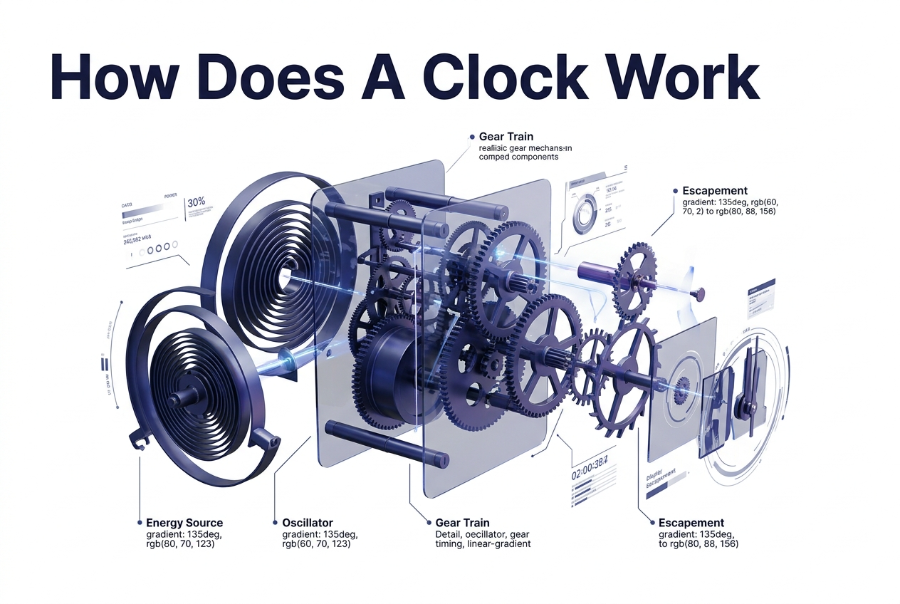
Most clocks have four essential parts: a power source, an oscillator, a counting mechanism, and a display. The power source keeps the system running. The oscillator creates the steady rhythm. The counting mechanism tracks each beat, and the display shows the result.
In a mechanical clock, these parts are physical components such as springs, gears, and hands. In a digital clock, they are batteries, crystals, chips, and screens. The materials change, but the purpose remains the same across nearly every timekeeping device.
Key Parts Found in Most Clocks
- Power source: battery, spring, weight, or electrical supply
- Oscillator: pendulum, balance wheel, quartz crystal, or atomic signal
- Regulator: controls how power is released
- Counter: tracks seconds, minutes, and hours
- Display: hands, numbers, screen, or audio signal
- Adjustment system: lets the user set or correct the time
How Mechanical Clocks Keep Time
Mechanical clocks are powered by stored energy. In older clocks, a hanging weight slowly falls and pulls a gear train. In spring-driven clocks, a wound mainspring slowly unwinds. This stored energy must be released in small, controlled steps rather than all at once.
The escapement controls that release. It lets the gears move forward one small amount at a time, usually in rhythm with a pendulum or balance wheel. That steady release is what makes the hands move at the correct pace instead of spinning freely.
The Role of Gears in a Clock
Gears translate fast, repeated movements into useful time units. One gear may move once per second, while connected gears reduce or redirect that motion. Through careful ratios, the clock turns many small ticks into one minute-hand movement and one hour-hand movement.
This gear system is why the hands move at different speeds while staying connected. The second hand completes a circle every minute. The minute hand completes a circle every hour. The hour hand moves slower because the gear ratio reduces its motion further.
Mechanical Clock Movement Comparison
Clock Type | Power Source | Timekeeper | Common Use | Accuracy
Weight-driven clock | Hanging weight | Pendulum | Grandfather clocks | Good if level and maintained
Spring-driven clock | Wound spring | Balance wheel or pendulum | Mantel clocks, watches | Moderate to good
Automatic watch | Wrist motion | Balance wheel | Mechanical wristwatches | Good with servicing
Tower clock | Weights or motors | Pendulum or regulator | Public buildings | Good with maintenance
How a Pendulum Clock Works
A pendulum clock uses gravity and motion to create a steady beat. The pendulum swings left and right at a rate influenced mainly by its length. A longer pendulum swings more slowly, while a shorter pendulum swings more quickly.
The escapement gives the pendulum tiny pushes to keep it moving. At the same time, the pendulum controls when the gears advance. This partnership between swinging motion and gear movement is the heart of traditional pendulum timekeeping.
Why Pendulum Length Matters
The length of the pendulum affects the timing more than the weight at the bottom. A one-second pendulum has a specific length that allows each swing to match a predictable interval. Adjusting the pendulum nut changes that length slightly.
If a pendulum clock runs fast, the pendulum is usually too short. Lowering the bob lengthens the swing and slows the clock. If the clock runs slow, raising the bob shortens the swing and speeds it up.
How Watches Use a Balance Wheel
Portable mechanical watches cannot use long pendulums because they move with the wearer. Instead, they rely on a balance wheel and hairspring. The balance wheel rotates back and forth, while the spring pulls it toward its center position.
This motion acts like a tiny pendulum, creating regular oscillations inside the watch. The escapement releases gear movement in controlled steps, and the gear train turns those steps into the movement of the watch hands.
Important Facts About Mechanical Timekeeping
- Mechanical clocks need regular energy from winding, weights, or motion
- Friction slowly affects accuracy and wear
- Temperature can change the behavior of metal parts
- Lubrication is essential for long-term performance
- The escapement is one of the most important parts
- Mechanical watches often trade perfect accuracy for craftsmanship
How Quartz Clocks Work
Quartz clocks are the most common household clocks because they are affordable, accurate, and reliable. They use a small quartz crystal that vibrates when electricity passes through it. That vibration happens at a very stable frequency.
A circuit counts those vibrations and turns them into one-second pulses. In many quartz clocks, that pulse drives a tiny motor that moves the hands. In digital clocks, the pulse updates numbers on a screen instead.
Why Quartz Is So Accurate
Quartz is useful because it has a piezoelectric property. When electricity is applied, the crystal vibrates. When it vibrates, it also produces an electrical signal. This makes it ideal for creating a repeatable timing reference.
Most quartz watches use a crystal cut to vibrate 32,768 times per second. That number is easy for electronic circuits to divide repeatedly by two until they produce one pulse per second. This simple mathematical relationship helps keep time accurately.
How Digital Clocks Display Time
A digital clock usually starts with the same timing idea as a quartz clock. A quartz crystal provides a steady frequency, and an integrated circuit counts that frequency. Instead of moving hands, the clock updates numbers on a display.
The display may use LED, LCD, or another screen technology. The chip stores and updates the current time, often tracking hours, minutes, seconds, alarms, and calendar data. Many digital clocks also include buttons for setting modes and adjusting time.
Common Digital Clock Features
- 12-hour and 24-hour display modes
- Alarm and snooze functions
- Backlight or illuminated display
- Battery backup during power loss
- Calendar and temperature display
- Radio-controlled time updates
- Stopwatch or countdown timer
How Electric Clocks Work
Electric clocks use power from a wall outlet or battery to run a motor or electronic circuit. Older electric clocks often used synchronous motors, which relied on the stable frequency of the electrical grid to keep time.
Modern electric clocks usually use quartz timing instead. The electricity provides continuous power, while a crystal and circuit control accuracy. This makes them less dependent on grid frequency and more consistent in everyday use.
The Difference Between Analog and Digital Clocks
Analog clocks show time with hands moving around a dial. They represent time visually, which makes it easy to see how much time has passed or how much remains before the next hour. Many people find this helpful for planning.
Digital clocks show time with numbers. They are quick to read and often include extra functions. The internal timing method can be similar in both types, especially when both use quartz crystals. The main difference is how time is displayed.
Analog Versus Digital Clock Comparison
Feature | Analog Clock | Digital Clock
Display style | Moving hands | Numeric screen
Best for | Visual sense of time | Fast exact reading
Common mechanism | Mechanical or quartz | Quartz or electronic
Power use | Often low | Varies by display
Extra features | Usually limited | Often includes alarms and calendars
Maintenance | Depends on mechanism | Usually minimal
How Atomic Clocks Work
Atomic clocks measure time using the natural frequency of atoms. The most common standard uses cesium atoms, which change energy states at an extremely stable frequency. This allows scientists to define the second with extraordinary precision.
Unlike a wall clock, an atomic clock is a laboratory-grade instrument. It uses advanced electronics, controlled environments, and atomic behavior to maintain accuracy. Many devices sync indirectly to atomic time through radio signals, satellites, or internet time servers.
Why Atomic Time Matters
Atomic clocks support systems that need precise timing, such as GPS, telecommunications, financial networks, and scientific research. GPS satellites rely on extremely accurate clocks because tiny timing errors can cause major location errors.
Everyday devices benefit from atomic time even if they do not contain atomic clocks. Phones, computers, and smart devices often sync with internet time services, which trace back to national and international time standards.
Where Accurate Timekeeping Matters Most
- GPS navigation and mapping
- Banking and stock trading systems
- Mobile phone networks
- Internet servers and data centers
- Scientific experiments
- Aviation and transportation
- Broadcast systems and emergency communications
How Clocks Convert Seconds Into Minutes and Hours
Once a clock creates a steady second, it must count those seconds correctly. Sixty seconds make one minute, and sixty minutes make one hour. Mechanical clocks do this with gear ratios, while digital clocks use electronic counters.
This counting system is the reason clocks are both simple and precise. Whether the device uses brass gears or silicon circuits, it is essentially counting repeated events and grouping them into familiar units that people can read and use.
The Purpose of the Escapement
In a mechanical clock, the escapement is the part that stops stored energy from releasing too quickly. It locks and unlocks the gear train in rhythm with the oscillator. Each tick represents a controlled step forward.
Without an escapement, a wound spring or falling weight would release its energy in a burst. The escapement turns that raw energy into measured movement. It is the bridge between power and timekeeping accuracy.
Tips for Keeping a Clock Accurate
- Place pendulum clocks on a stable, level surface
- Replace weak batteries in quartz clocks promptly
- Keep mechanical clocks clean and properly lubricated
- Avoid placing clocks near heat sources or direct sunlight
- Service valuable mechanical watches at recommended intervals
- Sync digital devices to reliable network time when possible
Why Some Clocks Gain or Lose Time
A clock gains time when its oscillator runs too fast. It loses time when the oscillator runs too slowly. In mechanical clocks, this can happen because of friction, wear, temperature changes, poor leveling, or incorrect adjustment.
Quartz clocks can also drift, though usually by only a few seconds per month. Battery strength, crystal quality, circuit design, and temperature can all affect accuracy. Even good clocks need occasional correction to stay aligned with official time.
Environmental Effects on Clock Accuracy
Temperature can change the size and behavior of clock components. Metal expands and contracts, lubricants thicken or thin, and quartz crystals can shift slightly in frequency. These small changes may add up over days or weeks.
Position also matters for mechanical clocks and watches. A pendulum clock that is not level may tick unevenly. A mechanical watch may run differently depending on whether it rests face up, crown down, or on its side overnight.
How Smart Clocks and Phones Keep Time
Smart clocks, phones, and computers usually rely on internal quartz clocks but correct themselves through network synchronization. When connected to the internet, they compare their time against trusted time servers and adjust automatically.
This is why phones often show the correct time after traveling across time zones. The device receives location, network, or carrier information, then updates the displayed time. The internal clock keeps running between sync events.
How Radio-Controlled Clocks Work
Radio-controlled clocks receive time signals from official transmitters. In the United States, many clocks receive WWVB signals from the National Institute of Standards and Technology. These signals help the clock correct itself automatically.
The clock still has its own quartz movement, but it checks the broadcast signal periodically. If the internal time has drifted, the clock adjusts. This combines the convenience of a household clock with the reliability of official time.
Practical Examples of Modern Time Sync
- A phone updates time after changing time zones
- A laptop corrects clock drift using internet time servers
- A radio-controlled wall clock adjusts overnight
- A smartwatch syncs with a paired phone
- A GPS device receives precise satellite timing
- A server uses network time protocol for accurate logs
Why Clocks Use Base Sixty Time
Modern clocks divide time into sixty seconds and sixty minutes because of ancient counting systems. The base-sixty system was used by the Babylonians and remained useful because sixty divides cleanly by many numbers.
This makes time easy to split into halves, thirds, quarters, fifths, and tenths. The system survived because it was practical. Clocks later adopted these divisions and turned them into the familiar dial and digital formats we use today.
The Clock Face and Human Readability
The circular clock face works well because it repeats naturally every twelve hours. People can quickly judge time by the angle of the hands, even without reading exact numbers. This visual pattern makes analog clocks useful at a glance.
Digital displays are better when exact time matters. Seeing 7:43 is faster than estimating hand positions. That is why digital clocks are common on phones, ovens, dashboards, and devices where quick precision is useful.
Useful Terms Related to Clock Design
Term | Meaning
Oscillator | Part that repeats at a steady rate
Escapement | Mechanism that controls gear movement
Gear train | Connected gears that transfer motion
Frequency | Number of cycles per second
Pendulum | Swinging weight used for timing
Quartz crystal | Vibrating crystal used in electronic clocks
Synchronization | Correcting time using an outside reference
How Different Clocks Suit Different Needs
A wall clock is built for easy reading across a room. A wristwatch is built for portability. A stopwatch is built for measuring short intervals. A tower clock is designed for public visibility and long-distance readability.
Each design balances accuracy, cost, durability, size, and style. A luxury mechanical watch may be less accurate than a cheap quartz watch, but it offers craftsmanship and repairability. A digital alarm clock favors convenience over mechanical beauty.
Choosing the Right Clock Type
For most homes, a quartz wall clock is the easiest choice because it is accurate and low maintenance. For collectors, mechanical clocks offer visible engineering and tradition. For workspaces, digital clocks provide quick reading and added features.
If precision matters, choose a clock that can sync automatically. Radio-controlled clocks, smart devices, and internet-connected systems reduce manual corrections. For decoration, mechanical and analog designs often provide more character than purely digital models.
Clock Selection Checklist
- Choose quartz for low maintenance
- Choose mechanical for craftsmanship and visible movement
- Choose digital for alarms, timers, and exact reading
- Choose radio-controlled for automatic accuracy
- Choose large analog faces for rooms and classrooms
- Choose smart clocks for connected features
- Choose durable materials for workshops or outdoor areas
Common Clock Problems and Fixes
If a battery clock stops, the battery is the first thing to check. Corroded contacts can also prevent power from reaching the movement. Cleaning the contacts carefully and installing a fresh battery often solves the issue.
If a pendulum clock stops, check whether it is level and whether the pendulum swings freely. Uneven ticking usually means the clock is out of beat. Valuable antique clocks should be adjusted by a qualified repairer.
When a Clock Needs Professional Service
Mechanical clocks need service when they run poorly, stop often, sound irregular, or show visible wear. Old oil can become sticky, increasing friction and causing damage. Regular maintenance helps preserve both accuracy and value.
Watches also benefit from professional servicing. A mechanical watch contains small parts under constant motion. Cleaning, lubrication, and regulation keep the movement healthy. For inherited or expensive pieces, careful service matters more than quick fixes.
Conclusion
Clocks work by turning steady repetition into readable time. A pendulum swings, a balance wheel rotates, a quartz crystal vibrates, or an atomic system measures a stable natural frequency. The clock counts that rhythm, organizes it into seconds and minutes, and shows it through hands, numbers, or connected displays.
The details vary, but the principle is consistent across old tower clocks, wristwatches, wall clocks, phones, and scientific instruments. Mechanical clocks reveal the beauty of gears and escapements, while quartz and digital clocks show how electronics made accuracy simple and affordable. Atomic clocks take the same idea to the highest level of precision. Once you know how does a clock work, every tick becomes easier to appreciate because it represents controlled energy, repeated motion, and careful design working together.
FAQ
How does a clock keep ticking?
A clock keeps ticking by releasing energy in controlled steps. In mechanical clocks, the escapement regulates gear movement. In quartz clocks, an electronic circuit counts crystal vibrations and sends regular pulses to move hands or update a display.
Why do clocks have twelve numbers?
Most analog clocks use twelve numbers because the day was historically divided into two twelve-hour periods. This format fits neatly on a circular dial and makes it easy to read hours with rotating hands.
What makes a quartz clock accurate?
A quartz clock is accurate because its crystal vibrates at a very stable frequency when powered by electricity. The circuit counts those vibrations and divides them into seconds, keeping time with little drift.
Why does a pendulum clock stop?
A pendulum clock may stop if it is not level, lacks power, has dirty parts, or the pendulum cannot swing freely. Friction and poor adjustment are common causes, especially in older mechanical clocks.
Are digital clocks more accurate than analog clocks?
Digital clocks are not automatically more accurate than analog clocks. Accuracy depends on the timing mechanism inside. A quartz analog clock can be just as accurate as a quartz digital clock using the same frequency source.
0 Comments