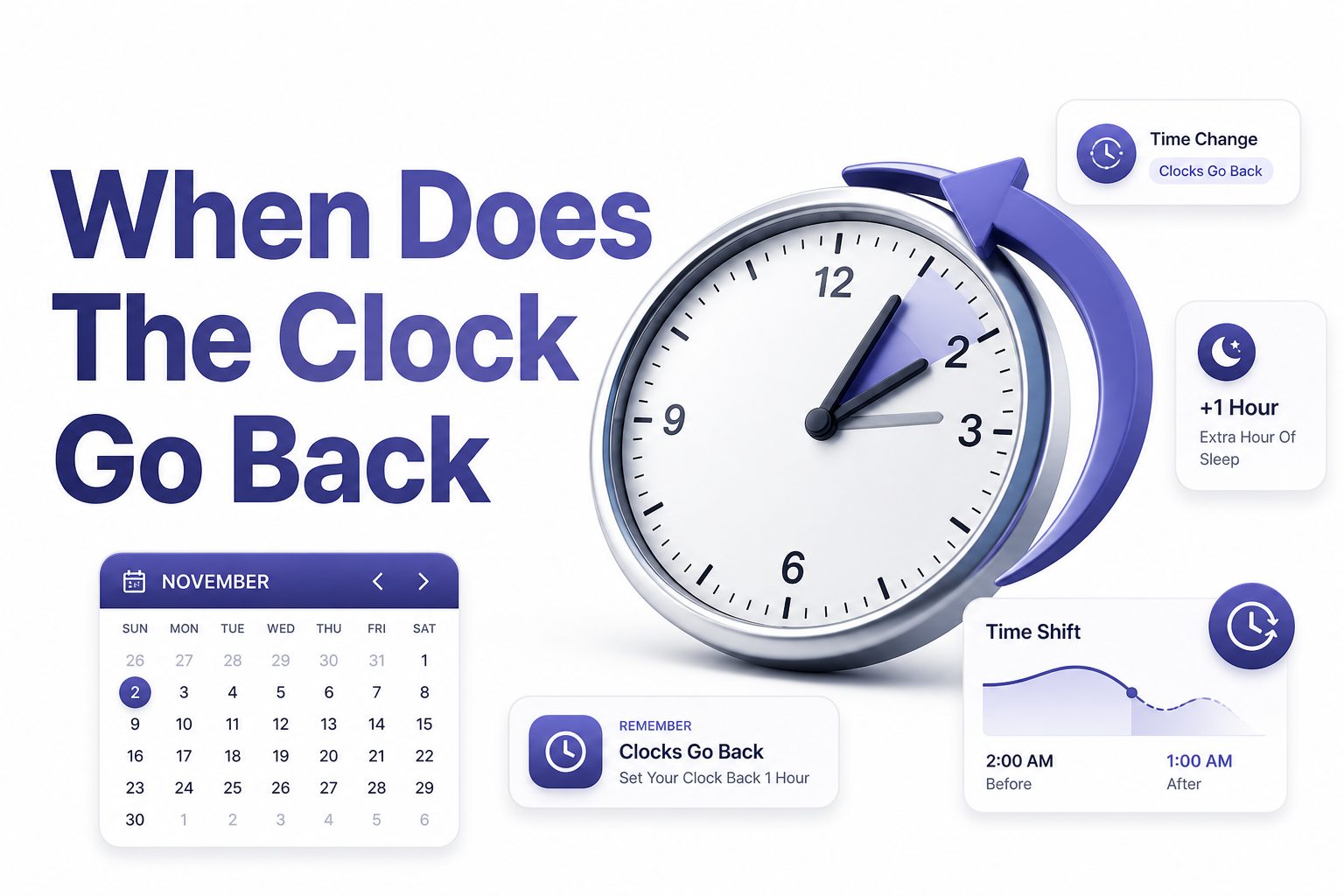
When does the clock go back is one of those seasonal questions that seems simple until you need the exact date, time, and practical meaning. In the UK, the clocks go back on Sunday 25 October 2026 at 2:00am, moving back one hour to 1:00am. That marks the end of British Summer Time and the return to Greenwich Mean Time.
For most people, the change brings an extra hour in bed, earlier sunrise, and darker evenings. It also affects alarms, travel plans, shift work, international meetings, and daily routines. Phones and connected devices usually update automatically, but some clocks still need changing by hand. This guide explains the date, why the change happens, what to expect, and how to make the switch easier.
When the Clock Goes Back in the UK
In the UK, the clock goes back on the last Sunday in October each year. For 2026, that date is Sunday 25 October. At 2:00am British Summer Time, clocks move back one hour to 1:00am Greenwich Mean Time.
This change gives the UK lighter mornings for a period after the switch, although evenings become darker earlier. It is the autumn clock change, often remembered with the phrase “spring forward, fall back,” because clocks move forward in March and back in October.
Why the Clock Goes Back
The clock goes back because the UK moves from British Summer Time to Greenwich Mean Time. British Summer Time shifts the clock forward by one hour during warmer months, giving longer daylight in the evening when many people are active.
When autumn arrives, daylight hours shorten naturally. Moving the clock back brings morning light earlier again, which can help schools, commuters, and morning routines. The change does not create extra daylight; it simply shifts how daylight lines up with civil time.
Quick Facts About the Clock Change
The UK clocks go back on Sunday 25 October 2026.
The time changes at 2:00am, moving back to 1:00am.
The UK returns from British Summer Time to Greenwich Mean Time.
Most smartphones, laptops, and tablets update automatically.
Manual clocks, ovens, cars, watches, and heating timers may need adjusting.
The clock goes forward again on Sunday 29 March 2026 before going back in October.
What Happens at 2:00am
At 2:00am on the clock change date, the time immediately becomes 1:00am again. This means the hour between 1:00am and 2:00am happens twice, which matters for overnight workers, public transport, ticketing, and digital records.
For most households, the change happens while people are asleep. If your alarm is set on a smartphone, it should follow the updated time. A traditional alarm clock, wall clock, or car clock may still show the old time until you change it.
British Summer Time and Greenwich Mean Time
British Summer Time is the period when the UK is one hour ahead of Greenwich Mean Time. It starts when clocks go forward in late March and ends when clocks go back in late October. During BST, evenings stay lighter later.
Greenwich Mean Time is the UK’s standard time during winter. When the clock goes back, the UK returns to GMT. This is also the time reference strongly linked with Greenwich, London, and international timekeeping history.
Clock Change Comparison
Period: British Summer Time
When it starts: Last Sunday in March
Clock direction: Forward one hour
Main effect: Lighter evenings
UK time offset: GMT+1
Period: Greenwich Mean Time
When it starts: Last Sunday in October
Clock direction: Back one hour
Main effect: Lighter mornings
UK time offset: GMT
How the Clock Change Affects Sleep
The autumn clock change is usually easier on sleep than the spring change because it gives people an extra hour. Still, body clocks do not always adjust instantly, especially for children, older adults, and people with fixed sleep patterns.
A small shift in bedtime over a few days can make the change feel smoother. Going to bed slightly later before the change, keeping morning light exposure consistent, and avoiding long lie-ins can help your routine settle quickly.
How It Affects Work and School
For office workers and students, the main effect is the change in daylight. Morning journeys may feel brighter for a while, but the return journey often becomes darker. This can affect mood, alertness, and how people plan their evenings.
Shift workers may experience a more direct impact. If someone works overnight when the time changes, the repeated hour can affect pay, scheduling, and records. Employers should make timekeeping rules clear before the clock change weekend.
Simple Clock Change Checklist
Check manual clocks before going to bed on Saturday night.
Confirm alarms on phones, tablets, and smart speakers.
Adjust car clocks, oven clocks, and central heating timers.
Check travel times if you have an early Sunday journey.
Review work schedules if you are on an overnight shift.
Give children a few days to settle into the new routine.
Plan evening activities with earlier darkness in mind.
Digital Devices and Manual Clocks
Most internet-connected devices update automatically because they use network time settings. Smartphones, laptops, tablets, smart watches, and many connected home devices normally change without any action from the user.
Manual clocks still need attention. Wall clocks, analogue watches, some car dashboards, ovens, microwaves, and older heating controls may not update. It is worth checking them on Sunday morning to avoid confusion later in the day.
Travel, Flights, and Public Transport
The autumn clock change can affect travel plans, especially if you are travelling early on Sunday morning. Airlines, rail companies, and coach operators usually publish schedules in local time, but it is still wise to check your booking.
International travel needs extra care because not every country changes clocks on the same date. The United States, for example, usually ends daylight saving later than the UK. That short gap can temporarily change time differences for calls and flights.
Travel Planning Tips
Check your departure time directly with the airline, rail operator, or booking app.
Do not rely only on a screenshot taken before the clock change.
Allow extra time for early morning connections.
Check international meeting times after the UK returns to GMT.
Update calendar settings if you manually manage time zones.
Confirm hotel checkout times if travelling across a time change weekend.
Why Evenings Feel Darker After the Change
After the clock goes back, sunset appears one hour earlier on the clock. The actual amount of daylight continues to shorten because of the season, but the clock change makes the darker evening feel more sudden.
This is why many people notice the change most during the first working week after the clocks go back. A commute that happened in late daylight may now happen after sunset, especially across northern parts of the UK.
Effects on Health and Mood
The autumn clock change can affect mood because evening daylight becomes limited. Some people feel lower energy, reduced motivation, or changes in sleep timing as daylight patterns shift. These effects are usually mild but still noticeable.
Morning daylight can help reset the body clock. Getting outside early, keeping regular meals, and maintaining exercise can support adjustment. For people prone to seasonal mood changes, planning daylight exposure becomes more important as winter approaches.
Healthy Adjustment Ideas
Get daylight soon after waking where possible.
Keep bedtime and wake time consistent for several days.
Avoid using the extra hour for very late nights.
Move evening exercise earlier if darkness affects motivation.
Prepare children’s routines gradually before the change.
Keep bedrooms dark at night and bright in the morning.
Use reminders for medication or timed tasks if routines shift.
The Clock Change Across Europe
Most European countries also change clocks on the last Sunday in October. In 2026, many European countries return to standard time on Sunday 25 October, matching the UK date but not always the same local clock time.
Time zones still matter. In Central Europe, clocks typically move back from 3:00am to 2:00am local time. This includes countries such as Germany, France, Spain, Italy, Poland, Austria, and many others using Central European Time in winter.
The Clock Change in the United States
The United States usually changes clocks on a different schedule from the UK and Europe. In 2026, daylight saving time in most US states ends on Sunday 1 November, when clocks go back one hour at 2:00am local time.
This creates a short period when time differences are not what people expect. For example, the UK and New York are normally five hours apart in winter, but the gap briefly changes after the UK moves back before the US does.
UK, Europe, and US Clock Change Dates
Location: United Kingdom
2026 clocks go back: Sunday 25 October
Typical change time: 2:00am to 1:00am
Winter time: Greenwich Mean Time
Location: Central Europe
2026 clocks go back: Sunday 25 October
Typical change time: 3:00am to 2:00am
Winter time: Central European Time
Location: United States
2026 clocks go back: Sunday 1 November
Typical change time: 2:00am to 1:00am
Winter time: Standard time by time zone
Common Mistakes People Make
One common mistake is assuming every country changes clocks on the same weekend. This can lead to missed calls, late meetings, or confusion around deadlines. International calendars usually handle this well, but manually calculated time differences can be wrong.
Another mistake is forgetting older devices. A phone may show the correct time, while a car clock or kitchen appliance remains one hour out. This is especially easy to miss if you check the wrong clock before leaving home.
How to Remember the Direction
The easiest memory aid is “spring forward, fall back.” In spring, clocks move forward by one hour. In autumn, or fall, clocks move back by one hour. The phrase works because it links the direction to the season.
Another practical way to think about it is daylight. When clocks go back, mornings become lighter and evenings become darker. If you gain an hour in bed, it is the autumn change. If you lose an hour, it is the spring change.
Reminder Methods That Work
Set a phone reminder for the Saturday evening before the change.
Change manual clocks before going to bed.
Use a shared family calendar note for travel or work shifts.
Add a reminder for heating timers and appliance clocks.
Check international meetings during the week before the change.
Keep “spring forward, fall back” as the simple rule.
Why the UK Still Changes the Clocks
The UK has used seasonal clock changes for many years, mainly to make better use of daylight during longer summer days. The system gives later sunsets in summer, which can benefit leisure, tourism, outdoor work, and evening activity.
There has been debate about ending clock changes, but no permanent change has replaced the current system. For now, the UK continues to move clocks forward in March and back in October each year.
The Debate Around Daylight Saving
Supporters often argue that British Summer Time makes evenings more useful during spring and summer. Longer evening daylight can encourage outdoor activity, reduce some lighting use, and support businesses that benefit from people being out later.
Critics point to disrupted sleep, darker winter evenings, and the inconvenience of changing clocks twice a year. Some also question whether energy savings are still meaningful in modern life, where electricity use patterns are very different from the past.
Arguments For and Against Clock Changes
For clock changes:
Longer summer evenings for leisure and outdoor activity.
Better use of daylight during warmer months.
Potential benefits for tourism and evening trade.
A familiar routine already built into calendars and systems.
Against clock changes:
Sleep disruption for some people.
Darker evenings after the autumn change.
Temporary confusion for travel and international meetings.
Questions over whether energy savings are still significant.
Practical Examples for Daily Life
If you wake at 7:00am on the Monday after the clock change, your body may feel like it is 8:00am under the previous schedule. That can make the first morning feel easier, especially if you usually struggle to wake up.
The evening feels different. A sunset that was around 5:45pm before the change may feel closer to 4:45pm afterward, depending on location and date. This is why evening walks, school pickups, and commutes can suddenly feel much darker.
Planning Ahead for Families
Families with young children often notice the change more than adults. A child who usually wakes at 6:30am may wake according to their body clock rather than the new clock time, making mornings feel unusually early for a few days.
A gradual routine shift can help. Moving bedtime, meals, and bath time by 10 to 15 minutes across several days often works better than expecting an instant adjustment. Keeping mornings bright and evenings calm also supports the transition.
Family Clock Change Tips
Adjust bedtime gradually during the week before the change.
Keep breakfast and dinner times steady after the switch.
Use blackout curtains if early waking becomes a problem.
Get children outside in morning daylight.
Avoid late screen time around the clock change weekend.
Be patient with mood changes during the first few days.
How Businesses Should Prepare
Businesses should check scheduling systems, payroll rules, and customer communications before the clock change. This matters most for transport, hospitality, healthcare, security, manufacturing, and any workplace with overnight shifts or timed bookings.
Customer-facing businesses should make opening hours clear, especially for Sunday appointments. Automated emails, booking systems, and reminders should use local time correctly. A small check before the change can prevent avoidable confusion.
Online Meetings and Remote Teams
Remote teams often feel the clock change because countries switch on different dates. A weekly meeting between London and New York may shift temporarily if one country has changed clocks and the other has not.
Calendar apps usually manage time zones well, but only when events are created with the correct location settings. Avoid typing times manually into messages without a time zone. For important meetings, include both local times for clarity.
Remote Work Checklist
Use calendar invites instead of informal time agreements.
Add time zones to meeting notes when working internationally.
Check recurring meetings after seasonal time changes.
Confirm deadlines that involve teams in different countries.
Avoid scheduling critical calls during the clock change weekend.
Use UTC for technical logs, releases, or cross-border operations.
When the Clock Goes Forward Again
In the UK, clocks go forward on the last Sunday in March. In 2026, that date is Sunday 29 March. At 1:00am, clocks move forward one hour to 2:00am, marking the start of British Summer Time.
That spring change removes an hour from the night, so many people find it harder than the autumn switch. The reward is later evening daylight, which becomes more noticeable as spring moves toward summer.
Key Dates to Remember
The two main UK clock changes in 2026 are Sunday 29 March and Sunday 25 October. March is the forward change into British Summer Time, while October is the backward change into Greenwich Mean Time.
A simple way to plan is to add both dates to your calendar at the start of the year. That gives you time to prepare for travel, childcare, shift work, international calls, and any routine that depends on precise timing.
Useful Internal Resources
For more seasonal planning advice, see [Internal Link: UK Daylight Saving Time Dates].
For practical home routine advice, visit [Internal Link: Seasonal Sleep Routine Tips].
Conclusion
The autumn time change is easy to manage once you know the exact date and what it means. In the UK, the clocks move back on Sunday 25 October 2026 at 2:00am, returning the country to Greenwich Mean Time. Most digital devices should update automatically, but manual clocks, heating systems, ovens, watches, and car dashboards may need checking.
The change brings lighter mornings for a while, darker evenings, and a small shift in sleep and daily routines. It can also affect overnight work, travel plans, international meetings, and family schedules. Preparing a few days ahead helps reduce confusion and makes the first week feel easier. So, when does the clock go back? In 2026, the key UK date is Sunday 25 October, and a quick reminder the night before should keep everything on track.
FAQ
When do the clocks go back in 2026?
In the UK, the clocks go back on Sunday 25 October 2026. At 2:00am, the time moves back one hour to 1:00am, marking the end of British Summer Time.
Do I get an extra hour in bed?
Yes, the autumn clock change gives most people an extra hour overnight. If you normally wake at the same clock time, the night is effectively one hour longer.
Do phones change time automatically?
Most smartphones, tablets, laptops, and smart watches update automatically if automatic time settings are turned on. Manual clocks, car dashboards, ovens, and older alarm clocks usually need changing by hand.
Why do evenings get darker after the clocks go back?
Evenings feel darker because sunset appears one hour earlier on the clock. The total daylight is also naturally decreasing in autumn, which makes the shift feel more noticeable.
Is the clock change the same everywhere?
No, countries use different daylight saving rules. The UK and much of Europe change on Sunday 25 October 2026, while most of the United States changes one week later, on Sunday 1 November 2026.
0 Comments